We recognise you by how you walk. Not by your face, your iris or your fingerprint.
At the heart of GeoNotary is a proprietary artificial-intelligence model that identifies a person by their biomechanical gait pattern: the unique way each body moves when walking. We have trained it with nearly 600 people over more than 3 years of controlled laboratory tests.
It is a biometric unlike any other —and, above all, far more respectful of your privacy.
How it works
Your phone's motion sensors measure, dozens of times per second, how you move. The model learns your gait signature and then verifies that it is you.
- 1Sensors
Accelerometer and gyroscope capture your movement at 50 samples per second.
- 2Gait pattern
Your unique biomechanical signature is extracted: rhythm, cadence, sway.
- 3On-device AI model
A proprietary model processes the pattern on the device itself, in the Secure Enclave.
- 41:1 verification
Confirms that whoever carries the phone is you —not someone else.
- 5Certificate
Sealed with a hash, eIDAS timestamp and blockchain. Unalterable.
Why it is the safest biometric for you
The face, the iris and the fingerprint are static, replicable data: they can be photographed, lifted from a surface or faked with a deepfake. And they are used everywhere —to open your phone, your car, your bank—, so if someone copies them, they can impersonate you. The way you walk, they cannot.
Traditional biometrics (replicable and intrusive)
- Face: copied with a photo or a deepfake.
- Iris: replicated from a high-resolution image.
- Fingerprint: lifted from any surface.
- Intrusive: it forces you to put your finger, look at the camera or scan your iris over and over.
- They open doors, phones and accounts: if stolen, you're impersonated.
Biomechanical biometrics (GeoNotary)
- Non-intrusive: no putting a finger, looking at the camera or scanning your iris each time. Passive capture in the background, with nothing for you to do.
- A dynamic pattern, not a fixed image that can be copied.
- Not used in any system in the world to open doors or accounts: no one has your gait stored anywhere else.
- Useless to impersonate you: even if leaked, it opens nothing.
- We don't keep your face, your iris or your fingerprint. Nothing to be used against you.
Be wary of anyone who asks for a photo of your face
A selfie or facial image is an especially sensitive biometric datum (art. 9 GDPR) and, above all, replicable: with a single photo devices and apps can be unlocked, or a deepfake fed to impersonate you. If a proof solution demands your face, it is asking you for exactly the most dangerous datum to hand over.
Why can't GeoNotary's biometric be replicated? Because the way you walk is not a fixed image that can be photographed, but a dynamic movement pattern —how your whole body coordinates over time—. It exists in no database or system to be stolen from, it cannot be lifted from a surface or captured at a distance, and not even you can reproduce it at will. Besides, it is processed locally, on your device: no "photo" of you ever leaves to impersonate you with.
We don't need to know who you are to protect you
The app does not require your real name to work. It records and certifies your presence continuously and privately. Only on the day you need an expert report or proof to defend yourself do you identify yourself to us, and we produce the document that links that record to you. Until then, your data has no name.
- No facial biometrics: it is not an art. 9.1 GDPR datum; it is a 1:1 verification tied to your account, analogous to local Face ID.
- Processed locally: the model runs in your device's Secure Enclave; your pattern is not transmitted.
- Encrypted in transit (TLS 1.2+), with App Attest (iOS) and Play Integrity (Android).
- Only you access your report. No third parties, no servers outside the EEA.
Forensic-grade precision
Not all biometrics are worth the same before a court. They are measured by their false acceptance rate (FAR) —the probability of mistaking one person for another—, under the international standard ISO/IEC 19795.
| Technology | FAR (false positives) | Level |
|---|---|---|
| Fingerprint / iris / DNA | ≈ 1 in 1,000,000 or better | Forensic standard |
| Phone unlock (FIDO) | 1 in 25,000 – 100,000 | Everyday use |
| Instant gait (state of the art) | 1 in 14 – 34 | Insufficient |
For more than 15 years, the scientific literature deemed reliable recognition by the way of walking unfeasible. GeoNotary has solved it with two reinforcing advances: a proprietary classifier (already 3 to 7 times more accurate than the state of the art) and retrospective temporal aggregation, which with a few seconds of walking brings reliability to forensic level:
| Seconds of walking | Effective FAR |
|---|---|
| ≈ 2 s | ≈ 1 in 100 |
| ≈ 4 s | ≈ 1 in 10,000 |
| ≈ 6 s | ≈ 1 in 1,000,000 (forensic level) |
| ≈ 8 s | ≈ 1 in 100,000,000 |
Reliability comparable to the fingerprint or the iris —the only biometrics admitted in forensic settings— but without their weaknesses. And practically impossible to imitate: in imitation studies, 5 out of 7 intensively trained subjects (two weeks, 5 hours a day) failed when trying to copy another person's way of walking.
Years of laboratory research
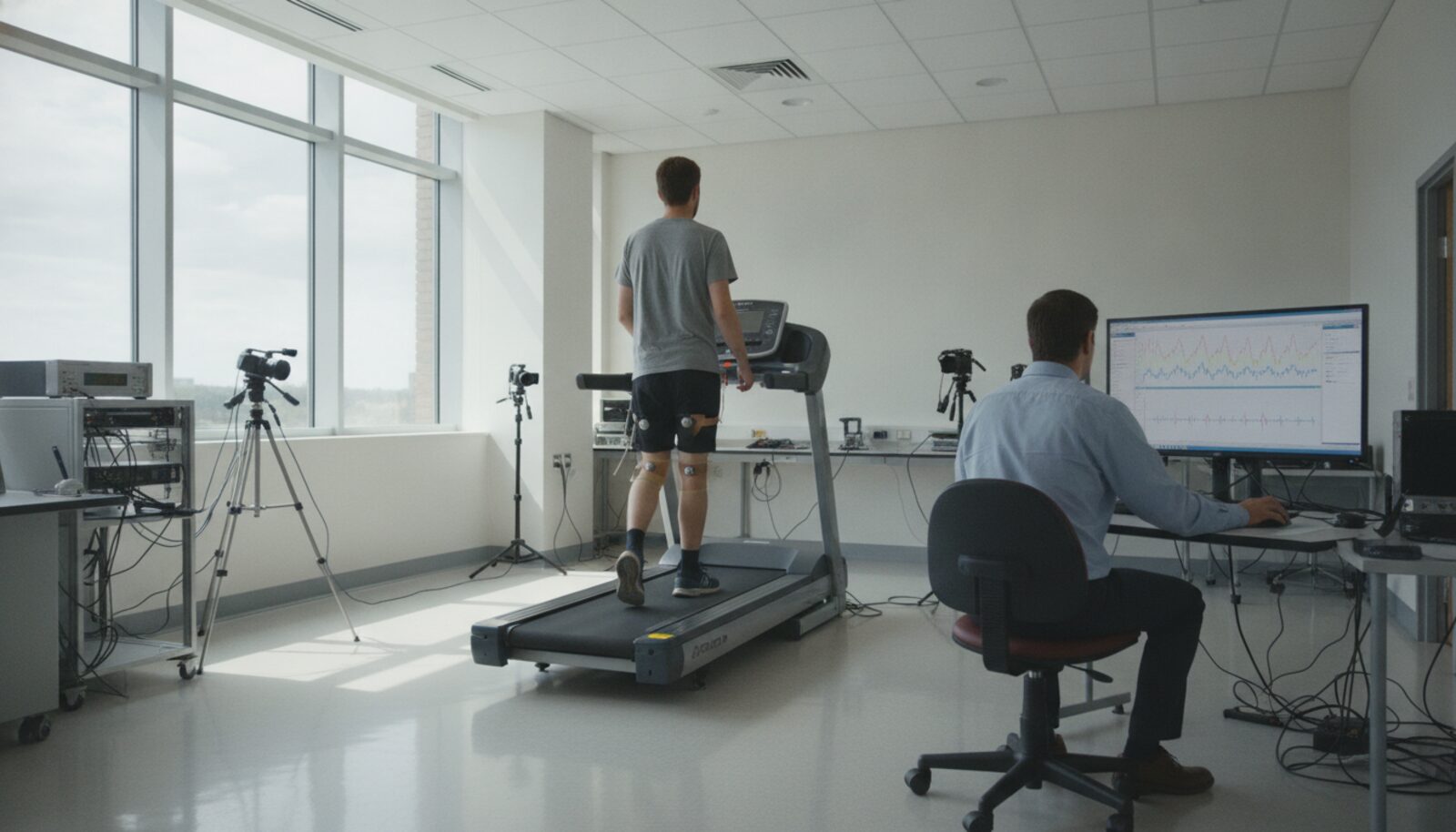
It is not a filter or an estimate. Behind the model lie more than 3 years of controlled tests: walking and running treadmills, different subjects, varied speeds and surfaces, to capture and isolate the patterns that reliably identify each person.
Solid proof starts with solid technology
Start recording your presence with maximum privacy and validity.
Con el respaldo de